Forum · Student writing · Taxes
From Reagan to Today: How America’s Tax System Has Changed
Taxes have always been a controversial subject in America, but the way we tax people has changed dramatically since Ronald Reagan became president in 1981. Reagan believed that lower taxes would encourage Americans to work, invest, and grow businesses. His ideas helped reshape th
 🇮🇶
By Tim Bolton
Vanderbilt · November 7, 2026 · 2 min read
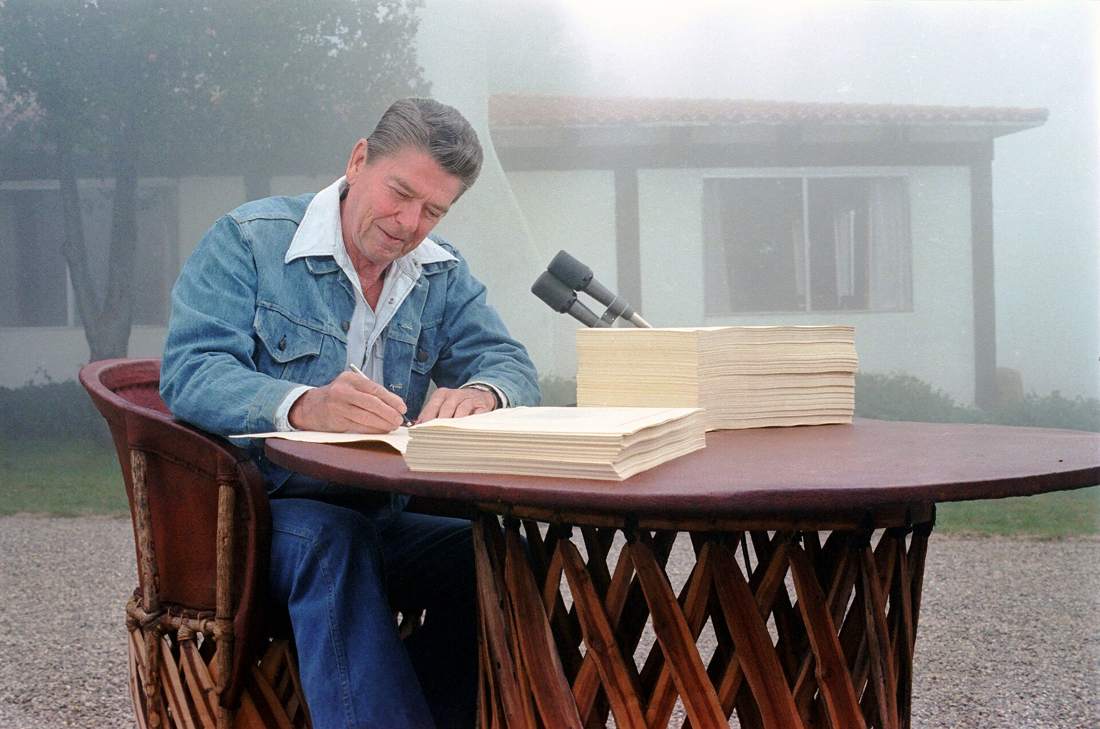
Reagan signs the Economic Recovery Tax Act, 1981. Photo: Karl Schumacher (official White House photographer), Public domain, via Wikimedia Commons.
Taxes have always been a controversial subject in America, but the way we tax people has changed dramatically since Ronald Reagan became president in 1981. Reagan believed that lower taxes would encourage Americans to work, invest, and grow businesses. His ideas helped reshape the American economy and continue to influence tax policy more than 40 years later.
When Reagan entered office, the highest federal income tax rate was 70%. By 1988, his administration had reduced that rate to just 28%. This was a massive change, especially for wealthy Americans. Reagan also simplified the tax system by eliminating many deductions and loopholes. His argument was simple: people should be able to keep more of the money they earn, giving them more incentive to contribute to the economy.
Chart
Top income tax rate
The highest national rate on the top slice of income
Since Reagan, tax rates have gone up and down depending on who occupies the White House. President Clinton raised the highest income tax rate to 39.6% in 1993, while President George W. Bush lowered it to 35% in 2003. In 2017, President Trump lowered the top rate to 37% and cut the corporate tax rate from 35% to 21%. The top individual rate remains 37% in 2026.
However, not every tax has decreased. In 1980, employees paid 6.13% of their wages toward Social Security and Medicare. Today, that figure is generally 7.65%. This means that even as income tax rates have fallen for wealthy Americans compared with the pre-Reagan era, payroll taxes have become a larger part of ordinary workers' paychecks.
One of the biggest questions is whether lower taxes actually pay for themselves through economic growth. The federal government ran a deficit of approximately $1.8 trillion in 2025, showing how difficult it remains to balance taxes and spending. Ultimately, the history of taxes since Reagan reflects a continuing American debate: how much money should people keep for themselves, and how much should they contribute to the government that serves them?
Related reading
Essay
Economic Inequality
Tracking the incomes of the richest: data from the World Inequality Database Inequality of what? Why WID and survey-based data measure different things
Joe Hasell
Political Writing
Donor Disclosure: 501(c) Groups and Campaign Spending
has, in the courts concerning this specific case—which is beyond the scope of this CRS product—the policy
Congressional Research Service
Essay
Government Spending
Public spending enables governments to produce and purchase goods and services in order to fulfill their objectives — such as the provision of public goods or the redistribution of resources. On this topic page, we study
Esteban Ortiz-Ospina
Now talk about it.
Discussion
Reply to this piece. You do not need to be published.
No discussion yet.
Create an account to reply or like.