Forum · Essay · Foreign Policy
Nuclear Weapons
The world’s nuclear powers have more than 12,000 nuclear warheads. These weapons can kill millions directly and, through their impact on agriculture, likely have the potential to kill billions .

By Bastian Herre, Pablo Rosado and Max Roser
Our World in Data · 2024 · 3 min read
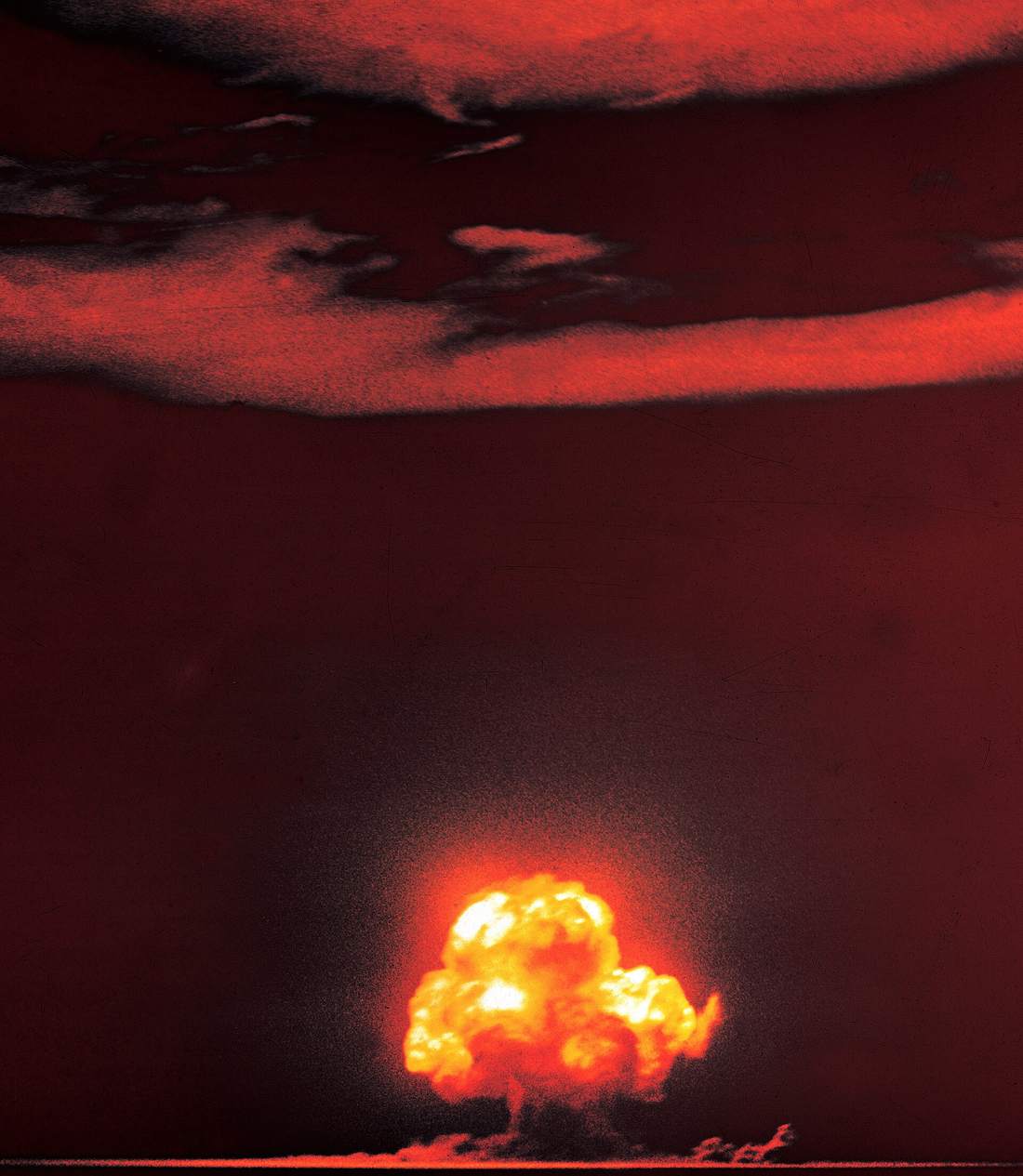
Trinity (nuclear test). Photo: Jack W. Aeby, July 16, 1945, Civilian worker at Los Alamos laboratory, working under the aegis of the Manhattan Project., Public domain, via Wikimedia Commons.
Illustration chosen by Counterpart. It is not part of the original Our World in Data article.
Authorized reading from Our World in Data. CC BY 4.0 Read the original →
The world’s nuclear powers have more than 12,000 nuclear warheads. These weapons can kill millions directly and, through their impact on agriculture, likely have the potential to kill billions .
Nuclear weapons killed between 110,000 and 210,000 people when the United States used them against the Japanese cities of Hiroshima and Nagasaki in August 1945. 1 They have come close to being used again more than a dozen times since.
Chart
Nuclear warhead stockpiles
Warheads held, including those in reserve
On this page, you can find writing, visualizations, and data on how many states have nuclear weapons, how many warheads they possess, how many oppose them, and how this has changed over time.
For an overview of the risks of nuclear weapons – and how they can be reduced – you can read the following essay:
The consequences of nuclear war would be devastating. Much more should – and can – be done to reduce the risk that humanity will ever fight such a war
How large are countries’ militaries? How much do they spend on their armed forces? Explore global data on military personnel and spending.
Nine countries currently have nuclear weapons: Russia, the United States, China, France, the United Kingdom, Pakistan, India, Israel, and North Korea.
These nuclear powers differ a lot in how many nuclear warheads they have. The chart shows that while most have dozens or a few hundred warheads, Russia and the United States have thousands of them.
The chart also shows that the warheads differ in how — and how quickly — they can be used: some are designed for strategic use away from the battlefield, such as against arms industries or infrastructure, while others are for nonstrategic, tactical use on the battlefield.
And while some warheads are not deployed, or even retired and queued for dismantlement, a substantial share of them is deployed on ballistic missiles or bomber bases and can be used quickly.
“Nine countries currently have nuclear weapons: Russia, the United States, China, France, the United Kingdom, Pakistan, India, Israel, and North Korea.”
The number of countries that possess nuclear weapons has never been higher. Only one country that had them — South Africa — entirely dismantled its arsenal .
But, as the chart shows, many more states had considered or pursued nuclear weapons, and almost all of them stopped.
In the late 1970s, more than a dozen countries considered them or pursued them by launching nuclear weapons programs, but almost all stopped. Only Syria has considered nuclear weapons recently, and only Iran has pursued building them .
Related reading
Political Writing
NATO: Issues for the July 2026 Ankara Summit
Heads of state and government from the North Atlantic Treaty Organization's (NATO's) 32 members are scheduled to meet for a summit in Ankara, Turkey, on July 7-8, 2026. NATO Secretary General Mark Rutte has outlined thre
Congressional Research Service
Commentary
NATO’s internal cohesion is being threatened (again) – but in pushing for support on Iran, Trump may risk eroding US influence on the alliance
Soon after the Israeli-U.S. war in Iran began on Feb. 28, 2026, U.S. President Donald Trump called upon NATO allies to help support the effort. The response of European leaders was at first mixed.
Michael A. Allen
Commentary
Europeans are concerned that the US will withdraw support from NATO. They are right to worry − Americans should, too
The United States has long played a leadership role in NATO, the most successful military alliance in history.
John Deni
Now talk about it.
Discussion
Reply to this piece. You do not need to be published.
No discussion yet.
Create an account to reply or like.