Forum · Commentary · Foreign Policy
Taiwan’s election was a clear show of defiance in the face of Chinese intimidation and pressure
Taiwan’s recent election result highlights voters’ steadfast determination to resist China’s influence on their politics. Despite all Beijing’s efforts to sway popular support towards its preferre

The Conversation · March 1, 2024 · 4 min read
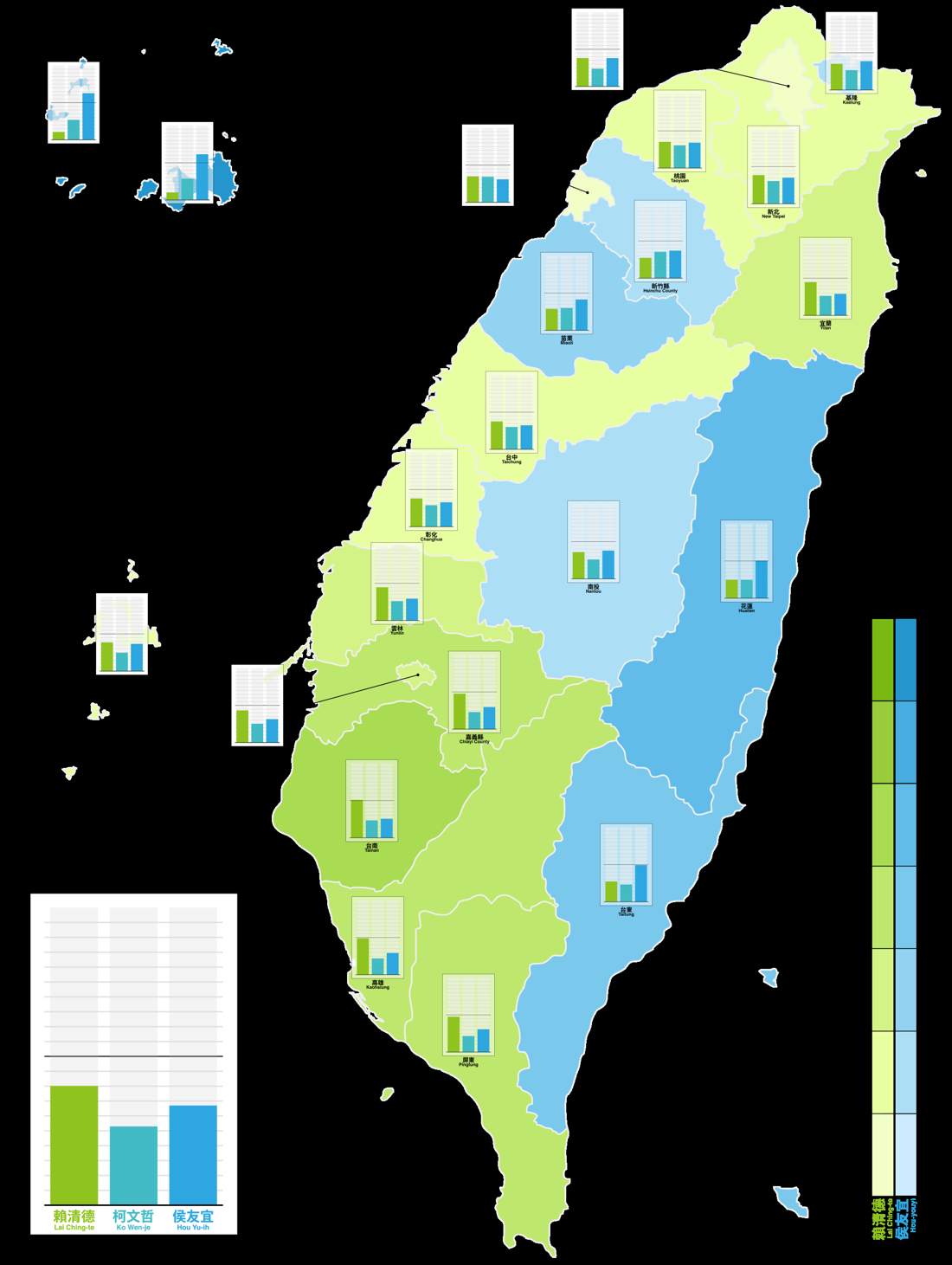
2024 Taiwanese presidential election. Photo: 沁水湾, CC BY-SA 4.0, via Wikimedia Commons.
Illustration chosen by Counterpart. It is not part of the original The Conversation article.
Authorized reading from The Conversation. CC BY-ND 4.0 Read the original →
Taiwan’s recent election result highlights voters’ steadfast determination to resist China’s influence on their politics. Despite all Beijing’s efforts to sway popular support towards its preferred party, the Kuomintang (KMT) , the election was won by the Democratic Progressive Party (DPP) candidate, incumbent vice-president William Lai.
Lai Ching-te, who is known as William in the west and Lai Qingde in mainland China, won with 40% of the vote. A nationalist who firmly supports Taiwanese independence from China, he scored a convincing victory over KMT candidate Hou Yu-ih, who placed second with 33.5%. In third place was Taiwan People’s Party (TPP) candidate Ko Wen-je, who received 26.5%.
Chart
Size of the economy
Gross domestic product, constant U.S. dollars
Lai will succeed the outgoing DPP president, Tsai Ing-wen, when he is inaugurated in May . His election is more than just a victory for Taiwan’s democratic values. It’s an unequivocal rejection by Taiwanese voters of Beijing’s persistent and intrusive meddling in their politics.
Since Taiwan first held direct presidential elections in 1996, Beijing has adeptly employed a dual-faceted strategy towards the island it claims as an inalienable part of its territory. Its “carrot-and-stick approach” is meticulously designed to appeal to voters’ sense of Chinese identity while also trying to steer them way from independence candidates.
This is very much of a piece with China’s complex relationship with Taiwan. It combines military intimidation and economic incentives, with informal influence operations targeting media organisations and civil society groups.
Beijing reacted to Lai’s election by restating its commitment to unification: “This election cannot change the basic pattern and direction of development of cross-strait relations … that the motherland will eventually be reunified.”
Beijing also reacted angrily to messages of congratulations received by Lai from an array of world leaders including the US secretary of state, Antony Blinken, and the British foreign secretary, David Cameron, who said that the result was “testament to Taiwan’s vibrant democracy”.
Chart
Military spending
Annual spending, constant U.S. dollars
Western involvement with Taiwan has been complicated by the fact that no major western power recognises Taiwan as an independent country. Instead, most countries pay at least official lip-service to Beijing’s “one China” policy .
This holds that Taiwan is the same country as the People’s Republic (mainland China). At the same time, Taiwan’s western allies supply it with arms to defend itself against any forced assimilation into China.
In reporting the election result, the international media focused squarely on what it suggested about Taiwan’s relations with the mainland. The message was clear in headlines such as “Taiwan voters rebuff China, ruling party gets third presidential term,” ( Reuters’ ) or “Taiwan Elects US-Friendly President, Defying China Warnings” ( Bloomberg ). Throughout the west the election was billed as a defiant Taiwan refusing to back down to Beijing.
It was against this tense backdrop that a five-member US congressional delegation led by the House China committee chairman, Mike Gallagher, arrived in Taipei to pay their respects to the president-elect. Gallagher, a known China hawk, assured Lai of his country’s continuing support.
He said: “I’m confident regardless of how the presidential election goes, we will maintain our support not only for Taiwan but also a posture of internationalism and engagement.”
Chart
Voter turnout
Votes cast as a share of the voting-age population
Gallagher’s trip angered Beijing, which demanded that the US cease any official contact with Taiwan . “China opposes any form of official interaction between the US and Taiwan authorities and rejects US interference in Taiwan affairs in whatever form or under whatever pretext,” a foreign ministry spokeswoman said, urging Washington to be “mindful of the extreme complexity and sensitivity” of the situation.
Taiwanese foreign minister, Jaushieh Joseph Wu, meanwhile, welcomed the visit : “Taiwan has been under tremendous military, economic, and also hybrid coercion by the PRC and under these circumstances, the visit of US congressmen has been of tremendous support to Taiwan.”
“Gallagher, a known China hawk, assured Lai of his country’s continuing support.”
Most recently, the response from the Chinese Communist party has taken a more strident tone. Wang Huning – a key figure overseeing Taiwanese affairs in China – urged the annual Taiwan Work Conference held in Beijing on February 23 to “resolutely combat ‘Taiwan independence’ separatism, curb interference from external forces, firmly support the patriotic unification forces on the island, broadly unite Taiwan compatriots, and maintain peace and stability across the Taiwan Strait”.
Meanwhile in Beijing: Wang Huning, politburo member responsible for Taiwanese affairs, urges China to fight Taiwanese independence. Yan Yan/Xinhua/Alamy Live News
Communist party rhetoric has also ramped up towards advocates of Taiwanese independence since the election. Where previously party officials had used the term “oppose” (fandui 反对), this year it has shifted to “kill” or “combat” (daji 打击) against “Taiwan separatists.”
It’s a notable change in tone compared to previous conferences. This more aggressive stance would appear to affirm widespread expectations that Beijing will intensify its attempts to push Taiwan towards unification.
China tried a range of gambits to interfere with the recent election. These ranged from hosting visits from hundreds of pro-Beijing Taiwanese local officials in the hope that they could use their influence to sway voters (carrot) to threatening to cancel trade concessions for Taiwanese businesses (stick).
There was deep-fake content pushing Beijing’s message and a blizzard of other misleading online content promoting conspiracy theories about DPP candidates. Chinese aircraft and spy balloons violated Taiwan’s airspace regularly during the campaign.
None of this worked. Turnout for the recent election was 71.86% – significantly higher than in the most recent elections in the US and UK. And there was clear distance between Lai’s 40% of the vote and the other candidates. Clearly the Taiwanese people value their democracy and wanted to send their own message to Beijing through the best medium there is: the ballot box.

Related reading
Political Writing
NATO: Issues for the July 2026 Ankara Summit
Heads of state and government from the North Atlantic Treaty Organization's (NATO's) 32 members are scheduled to meet for a summit in Ankara, Turkey, on July 7-8, 2026. NATO Secretary General Mark Rutte has outlined thre
Congressional Research Service
Commentary
How Homeland Security’s subpoenas and databases of protesters threaten the ‘uninhibited, robust, and wide‑open’ free speech protected by Supreme Court precedent
The U.S. Department of Homeland Security is reportedly issuing administrative subpoenas to identify anonymous social media accounts that criticize U.S. Immigration and Customs Enforcement. Google,
Stephanie A. (Sam) Martin
Academic Paper
My Understanding of Democracy: An Overview
Przeworski’s summary of when elections can process conflict without violence, and where his own theory still fails.
Adam Przeworski
Now talk about it.
Debate this issue
Should the United States commit to defending Taiwan if China attacks?
Discussion
Reply to this piece. You do not need to be published.
No discussion yet.
Create an account to reply or like.