Forum · Political Writing · Law
The Bill of Rights
From Amendments I–X to the Constitution of the United States
The first ten amendments: speech, arms, searches, juries, and the powers reserved to the states and the people.
The Avalon Project, Yale Law School · December 15, 1791 · 3 min read
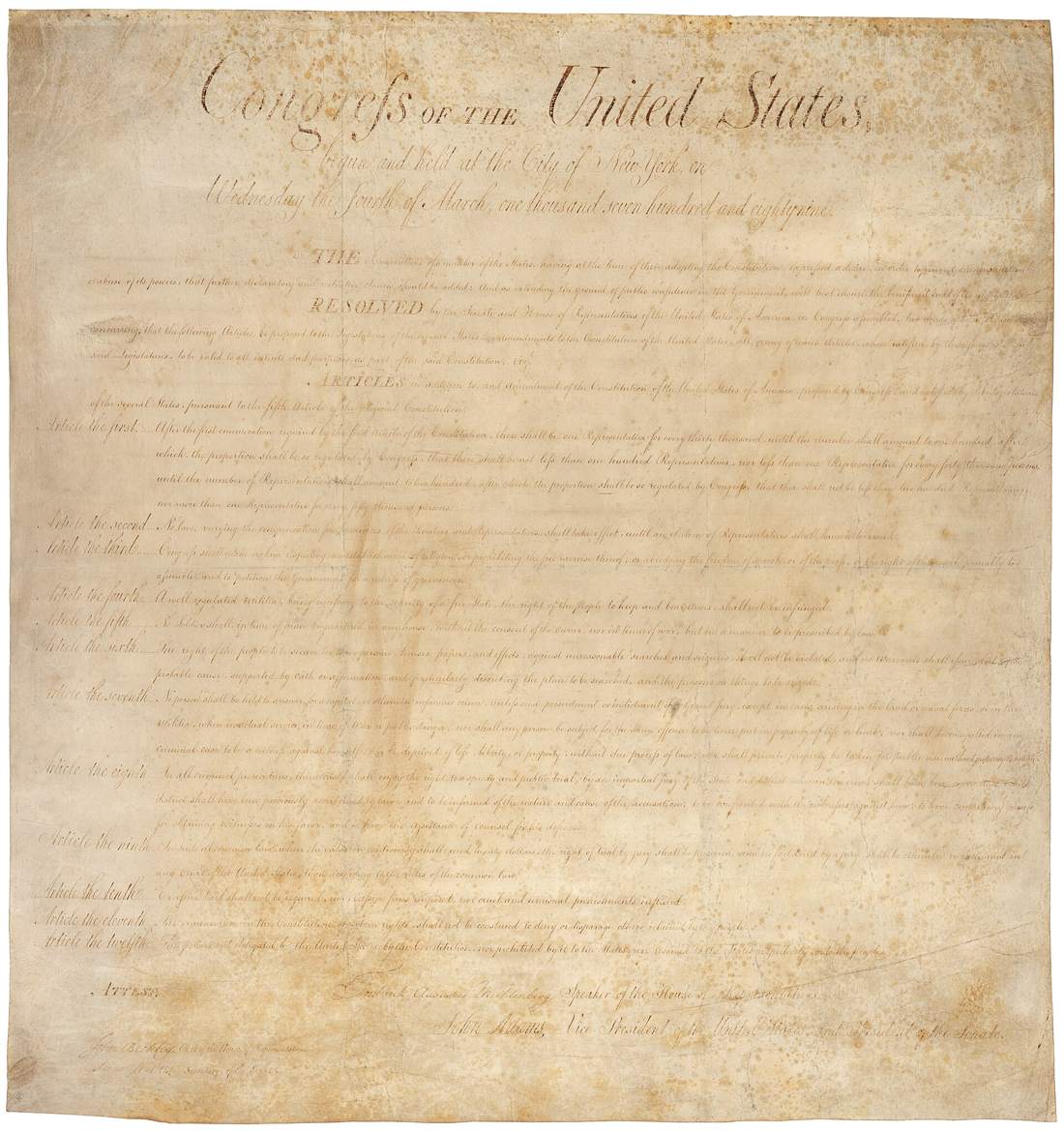
United States Bill of Rights. Photo: National Archives and Records Administration. Office of the Federal Register. 4/1/1985, Public domain, via Wikimedia Commons.
Illustration chosen by Counterpart. It is not part of the original The Avalon Project, Yale Law School article.
Authorized reading from The Avalon Project, Yale Law School. Public domain in the United States Read the original →
I - Freedom of Speech, Press, Religion and Petition II - Right to keep and bear arms III - Conditions for quarters of soldiers IV - Right of search and seizure regulated V - Provisons concerning prosecution VI - Right to a speedy trial, witnesses, etc. VII - Right to a trial by jury VIII - Excessive bail, cruel punishment IX - Rule of construction of Constitution X - Rights of the States under Constitution
Congress shall make no law respecting an establishment of religion, or prohibiting the free exercise thereof; or abridging the freedom of speech, or of the press; or the right of the people peaceably to assemble, and to petition the Government for a redress of grievances.

A speaker and crowd at Speakers' Corner, London, 1944. Photo: Ministry of Information official photographer, Public domain, via Wikimedia Commons.
Added by Counterpart editors.
A well-regulated militia, being necessary to the security of a free State, the right of the people to keep and bear arms, shall not be infringed.
No soldier shall, in time of peace be quartered in any house, without the consent of the owner, nor in time of war, but in a manner to be prescribed by law.
The right of the people to be secure in their persons, houses, papers, and effects, against unreasonable searches and seizures, shall not be violated, and no warrants shall issue, but upon probable cause, supported by oath or affirmation, and particularly describing the place to be searched, and the persons or things to be seized.
No person shall be held to answer for a capital, or otherwise infamous crime, unless on a presentment or indictment of a Grand Jury, except in cases arising in the land or naval forces, or in the militia, when in actual service in time of war or public danger; nor shall any person be subject for the same offense to be twice put in jeopardy of life or limb; nor shall be compelled in any criminal case to be a witness against himself, nor be deprived of life, liberty, or property, without due process of law; nor shall private property be taken for public use without just compensation.
“Excessive bail shall not be required, nor excessive fines imposed, nor cruel and unusual punishments inflicted.”
In all criminal prosecutions, the accused shall enjoy the right to a speedy and public trial, by an impartial jury of the State and district wherein the crime shall have been committed, which district shall have been previously ascertained by law, and to be informed of the nature and cause of the accusation; to be confronted with the witnesses against him; to have compulsory process for obtaining witnesses in his favor, and to have the assistance of counsel for his defense.
In suits at common law, where the value in controversy shall exceed twenty dollars, the right of trial by jury shall be preserved, and no fact tried by a jury shall be otherwise reexamined in any court of the United States, than according to the rules of the common law.
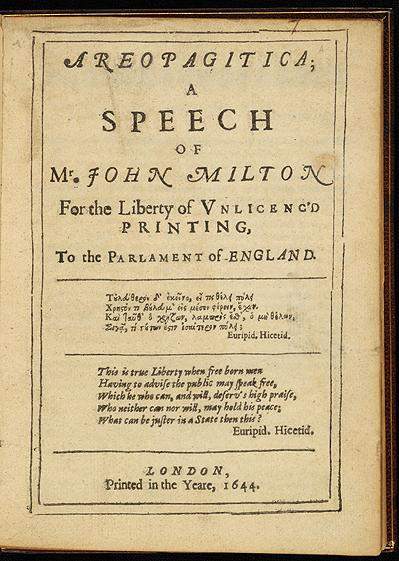
Areopagitica. Photo: John Milton, Public domain, via Wikimedia Commons.
Added by Counterpart editors.
Excessive bail shall not be required, nor excessive fines imposed, nor cruel and unusual punishments inflicted.
The enumeration in the Constitution, of certain rights, shall not be construed to deny or disparage others retained by the people.
The powers not delegated to the United States by the Constitution, nor prohibited by it to the States, are reserved to the States respectively, or to the people.
Article 7 United States Constitution Amendments 11-27 18 th Century Page
Related reading
Political Writing
NATO: Issues for the July 2026 Ankara Summit
Heads of state and government from the North Atlantic Treaty Organization's (NATO's) 32 members are scheduled to meet for a summit in Ankara, Turkey, on July 7-8, 2026. NATO Secretary General Mark Rutte has outlined thre
Congressional Research Service
Commentary
How Homeland Security’s subpoenas and databases of protesters threaten the ‘uninhibited, robust, and wide‑open’ free speech protected by Supreme Court precedent
The U.S. Department of Homeland Security is reportedly issuing administrative subpoenas to identify anonymous social media accounts that criticize U.S. Immigration and Customs Enforcement. Google,
Stephanie A. (Sam) Martin
Academic Paper
My Understanding of Democracy: An Overview
Przeworski’s summary of when elections can process conflict without violence, and where his own theory still fails.
Adam Przeworski
Now talk about it.
Debate this issue
Should universities be allowed to punish students for offensive speech?
Discussion
Reply to this piece. You do not need to be published.
No discussion yet.
Create an account to reply or like.